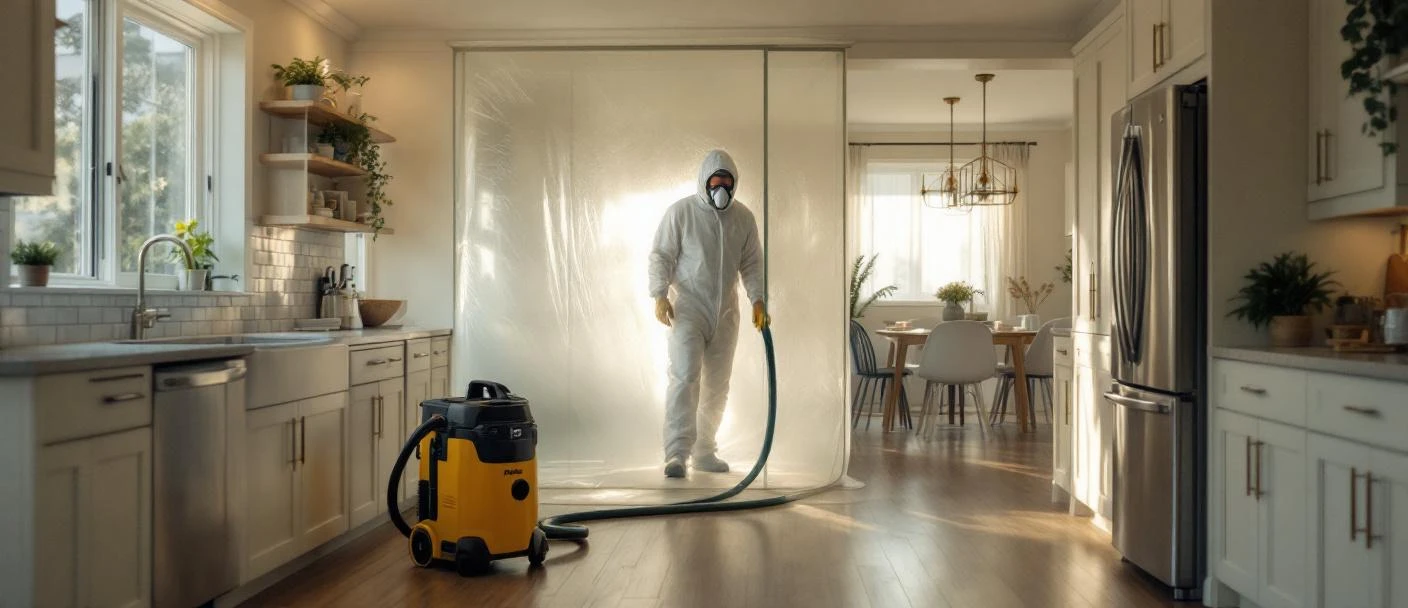
Mold Remediation Los Angeles
Mold remediation in Los Angeles by specialists trained on the IICRC S520 reference. Our team executes Condition 1/2/3 scoping, Level I–V containment, source removal, antimicrobial application, and independent third-party clearance verification across the LA basin.
What Is Mold Remediation in Los Angeles?
Mold remediation in Los Angeles is the IICRC S520 process of containing, removing, treating, and verifying mold colonization in residential and commercial structures. The process begins with a visual + moisture assessment to establish Conditions 1, 2, and 3 boundaries, then proceeds through containment setup, HEPA-filtered air management, physical removal of contaminated substrate, antimicrobial application as supplementary, and post-remediation verification.
The five-stage sequence — assessment, containment, filtration, removal, verification — is non-negotiable under the standard. Cleaning companies that skip containment or substitute biocide for physical removal violate the protocol and produce repeat-mold callbacks within months.
Our scope covers residential single-family, multi-family, condominium, and commercial light-occupancy buildings across Los Angeles County. Sewage Category 3 black water remediation under IICRC S500 sits adjacent to our standard scope with additional OSHA 29 CFR 1910.1030 bloodborne pathogen protocols and Tychem chemical-grade PPE.
What Mold Remediation Covers
Fourteen sub-services define the full IICRC S520 workflow. The first three are expanded by default; the remaining eleven sit in an accessible list below.
- 01
The Five Stages of Professional Microbial Remediation
Assessment, containment, HEPA-filtered air handling, removal and cleaning, and verification — the IICRC S520 sequence executed on every project. - 02
IICRC S520 Condition 1, 2, and 3 Classifications
Condition 1 (normal baseline, clearance target), Condition 2 (settled spores from a Condition 3 source, cross-contamination), and Condition 3 (active mold growth being remediated). - 03
Containment Level Selection — Level I Through Level V
Level I (<10 sq ft) through Level V (HVAC contamination). Level III (30–100 sq ft) uses 6-mil polyethylene, ZipWall, critical barriers, and a 3-zone decontamination chamber. - 04
HEPA-Filtered Negative Air Pressure
Phoenix R175 or BlueDri AS-600 negative-air scrubbers verified with a manometer at -5 Pa minimum differential. HEPA-filtered exhaust to outside or filtered recirculation. - 05
Source Removal Versus Source Containment
Paper-faced drywall demolition; framing salvage with dry ice blasting; carpet padding disposal; hardwood-floor and engineered-wood decisions under IICRC S520 §12. - 06
Antimicrobial and Biocide Application Under S520
Microban, Benefect, Sporicidin, Fiberlock ShockWave applied as supplementary, never as a substitute. The standard explicitly designates physical removal as primary; bleach is not appropriate on porous substrates. - 07
Encapsulation as the Final Step
Foster 40-50, Foster 40-80, or Fiberlock IAQ 2500 applied after physical removal to bind residual spores. Encapsulation is never a standalone shortcut over visible growth. - 08
Structural Drying After Water-Damage Remediation
IICRC S500 protocol with Dri-Eaz LGR 7000XLi, Quest 506, and B-Air air movers to wood <19% MC and drywall <1% MC before reconstruction prep. - 09
Basement Mold Remediation (LA Edge Cases)
Rare in LA, but documented in older Hollywood, Highland Park, and Echo Park hillside footings. Foundation leak repair, sub-floor sealing, and hydrostatic pressure relief sit on the structural side. - 10
Crawl Space Remediation Within General Process
General-process overview with vapor-barrier replacement, Bora-Care or Tim-Bor borate treatment, and Quest 506 dehumidifier integration. Full hillside crawl-space scope on the dedicated page. - 11
HVAC System Remediation Within General Process
NADCA ASCS combined with IICRC S520 Level V — evaporator coil cleaning, condensate pan replacement, plenum and supply-boot work. Full HVAC scope on the dedicated page. - 12
Sewage and Category 3 Black Water Cases
Tychem chemical-grade PPE, OSHA 29 CFR 1910.1030 bloodborne pathogen protocols, supplied-air respirator on confined-space sewage. Mandatory porous-material disposal under S500 Cat 3. - 13
Remediation in Occupied Buildings
Decontamination 3-zone chamber, negative-pressure HVAC handling, work-zone sealing, family scheduling, and pet relocation timing. Title 8 §5135 obligates workplace protections during occupied work. - 14
Reconstruction After Remediation
USG Mold Tough or DensArmor Plus mold-resistant drywall, Kilz Mold & Mildew Primer, Zinsser Perma-White paint. Reconstruction is a separate trade scope from remediation.
The Five Stages of Professional Microbial Remediation
Each stage has measurable completion criteria — moisture content thresholds, manometer readings, air-sample counts — before the project advances.
- 1
Stage 1 — Assessment
Visual inspection under IICRC S520 Section 12, moisture mapping with Delmhorst and Tramex meters, FLIR E-series thermal imaging, and tape-lift on suspect colonies for species ID.
- 2
Stage 2 — Containment
6-mil polyethylene sheeting with ZipWall and ZipPole, critical barriers on returns and electrical, decontamination 3-zone chamber, and -5 Pa minimum negative pressure verified by manometer.
- 3
Stage 3 — Air Filtration
Phoenix R175, Phoenix R225, BlueDri AS-600, or OmniAire 600V HEPA negative-air scrubbers sized per containment volume; HEPA-filtered exhaust to outside.
- 4
Stage 4 — Removal & Cleaning
Physical demolition of porous substrate, dry ice blasting on framing, HEPA-vacuum cleaning, antimicrobial application as supplementary, and encapsulation as final step.
- 5
Stage 5 — Verification
Visual reinspection to Condition 1, moisture content verification, indoor vs outdoor air sampling, and Certificate of Mold Remediation with chain-of-custody lab reports.
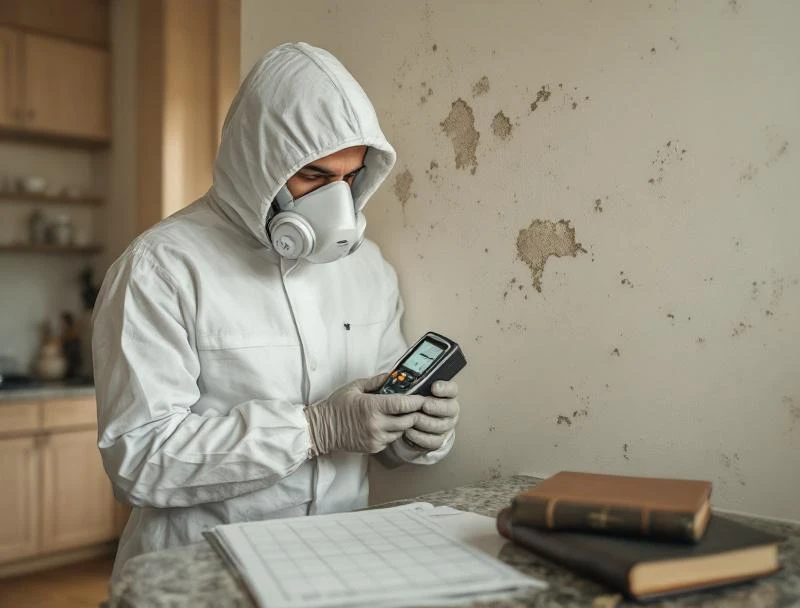
Estimate Your LA Mold Remediation Cost
The calculator applies IICRC S520 condition factors, surface multipliers, LA region multipliers, and clearance scope to produce a scenario-specific range.
Mold Remediation Cost Calculator (Los Angeles)
Estimates a range based on the IICRC S520 condition, surface type, and LA region. Final scope is set after on-site inspection.
Estimates apply LA labor multipliers and IICRC S520 condition factors. Final pricing follows on-site moisture mapping and containment-level determination.
Confirm with a specialist — Call (323) 645-3035IICRC S520 Condition 1, 2, and 3 — Explained
The three condition classes define both the remediation scope and the clearance target. Condition 1 is the goal at clearance.
Condition 1 — Normal Fungal Ecology
Condition 1 represents the normal indoor fungal ecology — background spore counts comparable to or lower than the outdoor environment, with no visible growth and no settled spore concentration above outdoor baseline. Every remediation project targets Condition 1 at clearance.
Verification under IICRC S520 requires Condition 1 visual reinspection (no visible growth in the remediated area), indoor air sampling at or below outdoor control with a matching species profile, and moisture-content verification on remaining substrate.
Condition 2 — Settled Spore Cross-Contamination
Condition 2 describes settled spore contamination from a Condition 3 source area — typically rooms or surfaces adjacent to active growth that have been exposed to dispersed spores. Condition 2 spaces do not have active mold growth but require cleaning to return to Condition 1.
Treatment is HEPA-vacuum cleaning of surfaces, damp-wiping of hard surfaces, and source removal of contaminated soft materials (carpet padding, dust-bound porous items). Containment Level I or II is typical, with HEPA AFD running during work.
Condition 3 — Actual Mold Growth
Condition 3 describes active mold growth on building substrate — colonization with hyphae, conidiophores, and sustained moisture. This is the area being remediated.
Treatment requires Level II, III, IV, or V containment based on area, source removal of porous substrate, antimicrobial application on framing and structural elements that cannot be removed, and full verification before reconstruction. Containment scope is governed by area: Level II 10–30 sq ft, Level III 30–100 sq ft, Level IV over 100 sq ft.

Equipment We Run on LA Remediation Projects
Professional-grade tools matter — and competitors that work from a residential vacuum and a spray bottle cannot deliver clearance under IICRC S520. The list below covers the equipment cluster on a Level II–III job.
Remediation equipment cluster
- Phoenix R175 / R225 HEPA negative-air scrubber, 1000–1700 CFM Level II–V containment
- BlueDri AS-600 HEPA AFD, 600 CFM compact Tight bath/closet scopes
- OmniAire 600V HEPA AFD, 600 CFM, variable speed Air-changes-per-hour sizing
- Dri-Eaz LGR 7000XLi Commercial LGR dehumidifier S500 structural drying
- Quest 506 Crawl-space and sub-area dehumidifier Encapsulated crawl space RH control
- Pullman-Holt 102ASB HEPA wet/dry vacuum Containment-zone cleaning
- Delmhorst BD-2100 Pin-type moisture meter Wood + drywall MC verification
- Tramex MEP Non-invasive moisture meter Pre-demolition moisture mapping
- FLIR E-series Handheld thermal imaging camera Hidden moisture identification
- 3M Versaflo PAPR Powered air-purifying respirator Severe Stachybotrys / Cat 3 sewage
- ZipWall + ZipPole Containment pole system Critical barriers and dust walls
- Foster 40-50 / 40-80 IAQ-rated mold encapsulant Final-step residual spore binding
Common Locations We Remediate in LA Homes
Hillside Bel Air and Pacific Palisades raised-foundation homes route remediation into our crawl space mold remediation in LA scope, where vapor-barrier failure and joist colonization dominate the project structure. Visible mold on supply-register grilles or coil slime in the air handler moves the project into our Level V HVAC mold remediation LA workflow under combined NADCA ACR and IICRC S520 standards.
Bathroom ceiling colonization above chronically saturated showers, attic sheathing colonization after roof-leak history, and crawl space joist mold under hillside marine-layer infiltration each route into their respective specialized service pages while the general process page documents the shared workflow.
Service Areas for Mold Remediation
Coverage spans the eight LA region groups. Coastal Westside ZIPs typically run 25–35% above basin median for equivalent scope due to labor density.
Westside
- Brentwood 90049
- Westwood 90024
- Bel Air 90077
- Beverly Hills 90212
- Santa Monica 90402
- Pacific Palisades 90272
- Venice 90291
- Mar Vista 90066
- Culver City 90232
- Marina del Rey 90292
Hollywood / Mid-City
- Hollywood 90028
- Hollywood Hills 90068
- West Hollywood 90069
- Hancock Park 90004
- Koreatown 90005
- Mid-Wilshire 90036
East / Northeast LA
- Silver Lake 90026
- Los Feliz 90027
- Atwater Village 90039
- Eagle Rock 90041
- Highland Park 90042
- Mount Washington 90065
San Fernando Valley
- Glendale 91205
- Burbank 91504
- North Hollywood 91601
- Studio City 91604
- Sherman Oaks 91423
- Encino 91316
- Tarzana 91335
- Woodland Hills 91367
- Northridge 91324
- Van Nuys 91406
Pasadena / East
- Pasadena 91101
- South Pasadena 91030
- San Marino 91108
- Altadena 91001
South Bay
- El Segundo 90245
- Manhattan Beach 90266
- Hermosa Beach 90254
- Redondo Beach 90277
- Torrance 90505
- Inglewood 90301
South LA
- Crenshaw / Baldwin Hills 90008
- South LA 90044
- Watts 90002
- Compton 90220
DTLA
- Downtown LA 90012
- Arts District 90013
- Bunker Hill 90071
Mold Remediation Cost Scenarios in Los Angeles
Twelve representative scenarios drawn from LA County remediation projects. Use these as anchor points before requesting a site-specific quote.
Whole-room Level III bedroom remediation in 90004 Hancock Park; plaster + lath complicates demolition.
Whole-attic remediation 1,200 sq ft in 90042 Highland Park Craftsman with original cellulose insulation replacement.
Full hillside crawl space + encapsulation 1,500 sq ft in 90068 Hollywood Hills with Quest 506 dehumidifier integration.
HVAC system remediation 1,800 sq ft home in 91367 Woodland Hills under NADCA ACR + S520 Level V.
Post-atmospheric-river whole-house 90272 Pacific Palisades with multi-room demolition and structural drying.
Post-fire ash + moisture mid-sized affected zone in 90272 Pacific Palisades, fire-debris coordination included.
Sewage Category 3 single-bathroom + adjacent hallway with Tychem PPE and porous-material disposal.
Condo shared-wall remediation in 90292 Marina del Rey with HOA coordination and EIFS cavity work.
Slab-leak hidden mold 1950s SFV tract home with cabinet removal and sub-floor work.
Polybutylene pipe-failure remediation in a 1980s Marina del Rey condo with behind-wall scope.
Cat 3 sewage whole-floor remediation in a 90013 Arts District loft with HVAC system involvement.
Standalone post-remediation clearance testing — 3 indoor air samples + outdoor control + visual reinspection.
Frequently Asked Questions
Related Services
Need Mold Remediation in Los Angeles? Get an LA-Local Scope.
Serving all of Los Angeles County.